Project Details
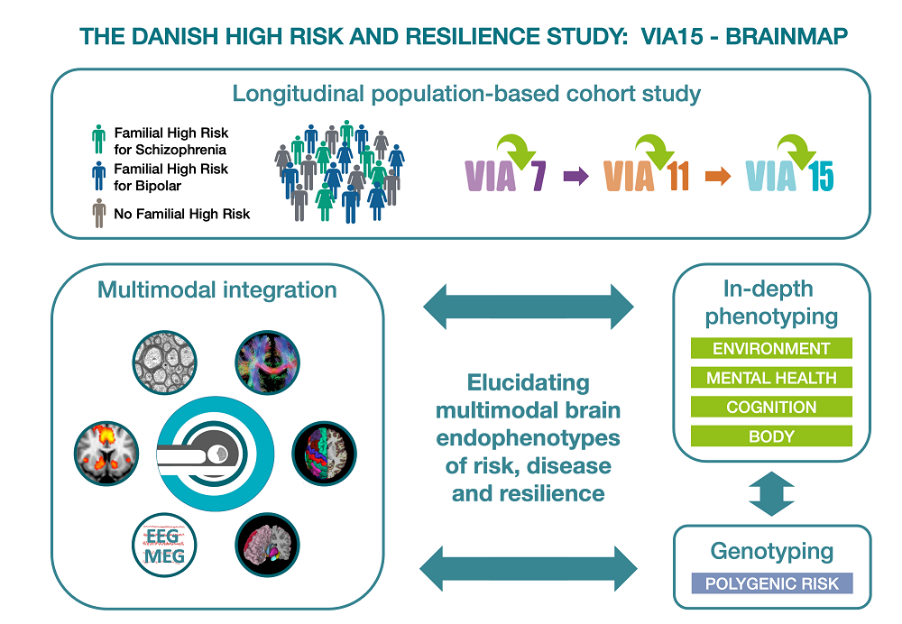
The Danish High Risk and Resilience Study – VIA (viaundersoegelsen.org) – is a national longitudinal study of 522 children at age seven (VIA7) born to parents with or without a diagnosis of either schizophrenia or bipolar disorder. “VIA” is the Latin word for road and describes the overall purpose of the project to investigate the developmental path of children with vulnerabilities.

The overarching hypothesis is that schizophrenia and bipolar disorder are neurodevelopmental disorders with significant genetic liabilities and influencing environmental exposures during pregnancy and early life. Approximately 550f all children born to parents suffering from schizophrenia or bipolar disorder will experience some kind of mental illness during their lifetime. Increasing our knowledge of both the risk and the protective factors associated with psychiatric disorders is important in identifying the most vulnerable children and in guiding the mental health services towards early intervention and health promotion. The VIA 11 and VIA 15 study assesses the same cognitive, social, emotional, clinical, and behavioral measures at age 11 and 15 as in the first study of the same cohort at age seven (VIA 7). In VIA 11 and 15 children are also assessed with anatomical and functional magnetic resonance imaging (MRI), and electroencephalography (EEG). Brain mapping in the VIA study is carried out in collaboration with the Center for Functional Integrative Neuroscience, Aarhus University (CFIN). The brain imaging protocol includes anatomical MRI and functional MRI probing cognitive control, social cognition, and the reward system. These cognitive dimensions are often already affected in early stages of mental illnesses. Additionally, we use EEG (DRCMR) and MEG (CFIN) to probe processes such as cognitive control, prediction errors as well as oscillatory activity in the gramma range. Our multimodal imaging approach combined with a multidimensional assessment of cognition, physical activity, environment, and genetics, will help differentiate factors that veer children on paths to health or to illness. We hope to take the next step and retest the same cohort at age 19.