The Computational Neuroscience of Reward Group
There are two strands to the group’s research agenda:
The first strand asks how do reward computations shape behaviour to regulate our physiology. Specifically, how are the values of primary rewards such as food and water configured by homeostatic states, and how should they be configured according to the constraints of survival. We are particularly interested in how models of this sort could provide a unified explanatory account of basic behavioural phenomena such as risk preferences, loss aversion, and temporal discounting. This work involves collaboration with endocrinologists, metabolic scientists, food scientists, and computational neuroscientists.
The second strand draws on a concept in physics known as ergodicity, and is the basis of the group’s connection to the London Mathematical Laboratory. Ergodicity here refers to thinking carefully about the types of averages that are relevant to behaviour, with a particular emphasis onhow decisions unfold over time. We are interested in the constraints that ergodicity imposes on decision-making, and whether such considerations can also offer a unified account of a number of disparate behavioral phenomena. We recently received funding from the Novo Nordisk Fonden to work together on experiments that expose subjects to different dynamical settings, testing how these dynamics modulate reward computations, and risk-taking behavior.
The group is committed to open science, and all future experiments will pre-register and release all code, materials, and data wherever possible. We also teach courses on the methods most central to our research, namely Bayesian statistics, as well as Bayesian modelling of cognition and the brain.
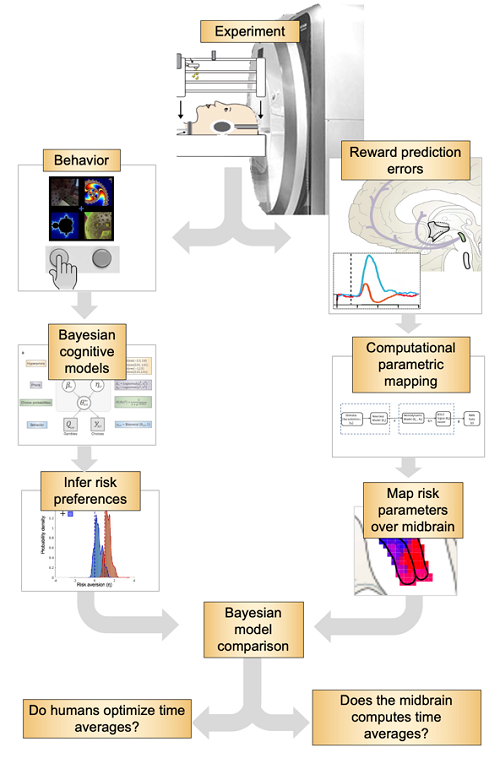
The figure above gives an example of how we use behavioural experiments to test theories of decision-making, and how this is combined with neuroimaging data which can be used to test the same theories, generating anatomical maps of hidden computational variables. This example here is for a project entitled “The ergodicity experiment”.
STUDENTS
We are always interested to hear from students with a quantitative training – physics, mathematics, computational biology, computational neuroscience, and related fields. If you are interested to work in the group please email with a brief explanation of your interests and situation. We recommend reading the work of the group and thinking carefully about what specifically you would like to do.
VIDEO TALKS & SOCIAL MEDIA
A short 1 minute video explainer of our work on risk-taking
https://www.youtube.com/shorts/_s6evl0Lu5U
A talk by Ollie Hulme on how classical theories of utility don’t actually maximise utility
https://youtu.be/J9lAJbfRzgQ?feature=shared
A talk by Marleen van der Weij talking about the technique of Computational Parametric mapping, and how it can be used to map cognitive models directly to fMRI activity
https://www.youtube.com/watch?v=P269KGl89Ew
A talk by Ollie Hulme on applying ergodic concepts to neural models of reward
https://www.youtube.com/watch?v=0OHrVzQdtvs
Ollie Hulme talking about his work with David Meder and risk preferences at Nudgestock
https://www.youtube.com/watch?v=XoCogIcEhi0&list=PPSV
Here is an accessible and short introduction to our work on ergodicity:
https://www.youtube.com/embed/XoCogIcEhi0
Recent talks by the group are available at this Youtube channel:
https://www.youtube.com/channel/UCEKr1X0owzn7zOjhPnt_OZQ
RELATED WORKS
Recent papers, blogposts, media, replications, critiques, and other related links discussing our research:
The Ergodicity Problem in Economics
Ole Peters in Nature Physics 2019
Reply to: Economists’ Views on the Ergodicity Problem
Reply to Peters by Doctor, Wakker & Wang 2020
Did Ergodicity Economics and the Copenhagen Experiment Really Falsify Expected Utility Theory?
Adam Goldstein 2020
Multi-period Expected Utility Theory Predicts Zero Risk Aversion in Copenhagen Experiment, Same as Ergodicity Economics.
Adam Goldstein 2020
Risk and Loss Aversion in Ergodicity Economics
Jason Collins
Everything We’ve Learned About Modern Economic Theory is Wrong
Brandon Kochkodin