The Cortico-Basal Ganglia Interactions Group
The research lab of Associate Professor Mattias Rickhag has established strong expertise in cellular neuroscience and viral modulation platforms for studying cortico-basal ganglia circuits in health and disease. We implement state-of-the-art genetic and viral-based tool allowing cell-type specific manipulations of cortical neuronal subpopulations to causally dissect these neural circuits and its relation to behavior using animal models. By use of engineered receptors (chemogenetics) and light-activated ion channels (optogenetics) in transgenic mouse models, we are able to target specific neuronal subsets and perturb their activity and correlate with behavioral outcomes. In parallel, we use pharmacological and toxin-based models of Parkinson’s disease (PD) in mice to mimic key motor symptomatology and whether targeted circuit modulation can reduce PD motor symptoms. Moreover, targeted expression of fluorescent biosensors and fiber photometric techniques will allow detailed assessment of neural activity and neurotransmitter release dynamics on a neuronal population level. This will allow us to capture neuronal network and neurotransmitter dynamics in the relevant brain circuits upon cell-type selective manipulations of relevant neuronal ensembles/subtypes and casually inform brain stimulation protocols.
It is the ambition that our research will fill major knowledge gaps regarding the involvement of cortico-basal ganglia systems for the genesis of parkinsonian motor symptoms and how to target them. Thus, we provide a strong link between preclinical and clinical research at DRCMR framing an interdisciplinary environment research that will yield mechanistic insights for how the motor cortex communicates with the basal ganglia to govern motor behavior in health and disease states such as Parkinson’s disease.
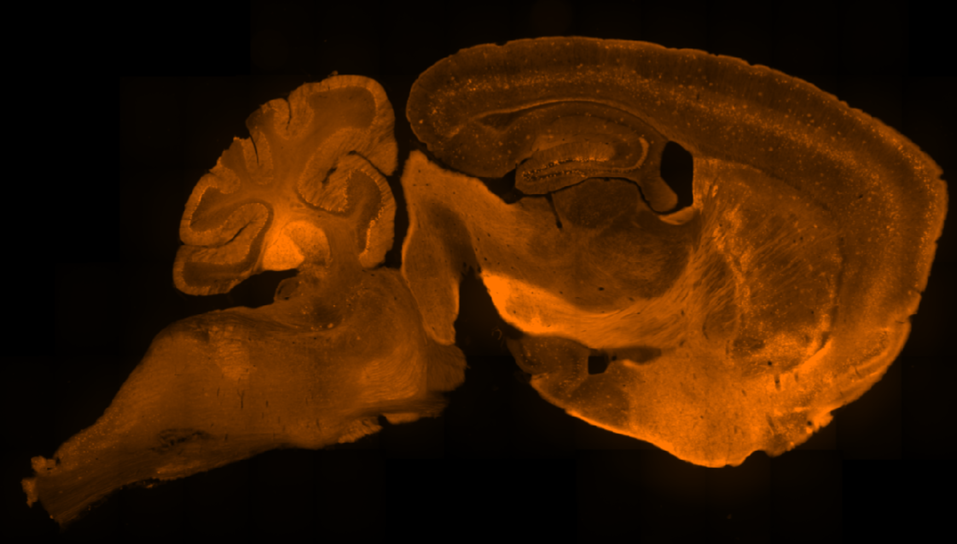
Depiction of the Chrna2-Tdtomato mouse line visualizing brain-wide Chrna2 expression in a sagittal mouse section
Key Projects
Role of Cortico-striatal projection systems in dopaminergic dyskinesias
A collaborative project to elucidate the role of sensorimotor cortical areas and corticostriatal projection systems in parkinsonian hypokinesia and dyskinesia using mouse models. The ultimate goal is to inform target selection for neuromodulation treatments acting on the cortex.
Goals of the project (main deliverables):
- To generate corticostriatal activity maps associated with specific profiles of dyskinetic-dystonic features
- To dissect pathophysiological changes to intratelencephalic (IT) and pyramidal tract (PT) corticostriatal systems
- To intervene in hypokinetic and dyskinetic motor abnormalities by modulating activity of intratelencephalic versus pyramidal tract pathways
People: Mattias Rickhag, Mihai Atudorei, Gustaf Olsson, Anna Gelman
Funding: Michael J. Fox Foundation
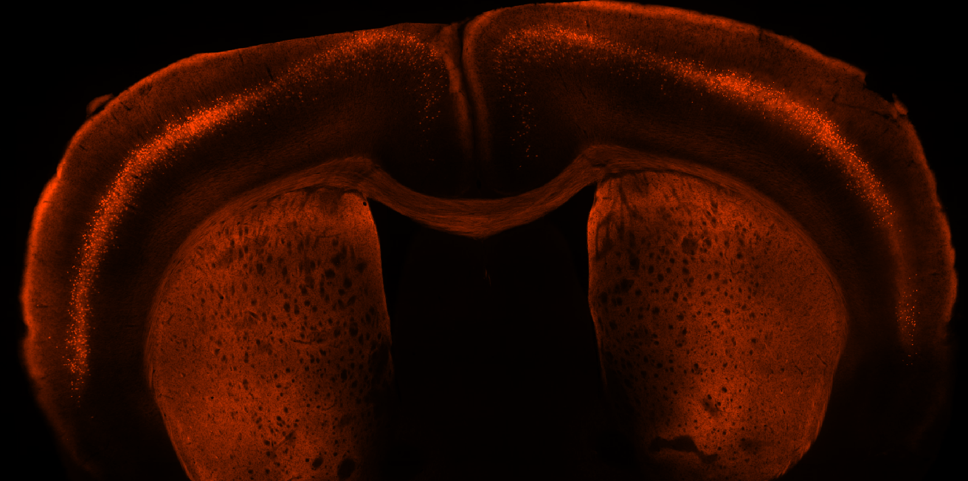
IT-type neuronal labeling: Tdtomato fluorescence imaging visualizing layer 5 IT-type neurons/corticostriatal projections. Atudorei 2025
Cortical Intratelencephalic Neurons Suppress Motor Actions in Mice by Recruitment of an Inhibitory Striatal Microcircuit
The cortico-basal ganglia circuits are instrumental for the selection of motor actions and an abnormal cortico-striatal connectivity plays a pivotal role in Parkinson’s disease. How distinct subpopulations of glutamatergic principal cells in the cortex directly govern general motor actions remains elusive and largely unexplored. The intratelencephalic tract (IT) and the pyramidal tract (PT) show complex and distinct axonal connectivity profiles, suggesting divergent functions. The PT neurons have received considerable focus while IT neurons remains poorly understood. The current proposal aims to investigate how selective activation of cortico-striatal IT neurons engage ensembles of separate striatal cell populations to control motor actions. The project will utilize advanced viral-genetic modulation strategies combining an optogenetic approach for selective modulation of cortico-striatal IT neurons in conjunction with fiber photometry to monitor neuronal activity dynamics in mice.
People: Mattias Rickhag, Mihai Atudorei, Gustaf Olsson, Anna Gelman
Funding: Independent Research Fund Denmark, Danmarks Frie Forskningsfond, DFF-1
Selected Publications
Atudorei M, del Agua Villa C, Gether U, Cenci MA, Siebner HR and Rickhag M (2025) Bilateral chemogenetic activation of Intratelencephalic Neurons in Motor Cortex Reduces Spontaneous Locomotor Activity in Mice. Neurobiology of Disease. 2024 Nov 26:106755. doi: 10.1016/j.nbd.2024.106755)
Del agua Villa C, Atudorei M, Siebner HR and Rickhag M (2024) Pharmacological Targeting of Dopamine D1 or D2 Receptors Evokes a Rapid-Onset, Distinct Parkinsonian Motor Phenotype in Mice. European Journal of Neuroscience. 2024 Dec 3. doi: 10.1111/ejn.16622)
Sørensen G, Rickhag M, Leo D, Lycas MD, Ridderstrøm PH, Weikop P, Lilja JH, Rifes P, Herborg F, Woldbye D, Wörtwein G, Gainetdinov RR, Fink-Jensen A, Gether U, Disruption of the PDZ-domain binding motif of the dopamine transporter uniquely alters nanoscale distribution, dopamine homeostasis and reward motivation, Journal of Biological Chemistry (2021), https:// doi.org/10.1016/j.jbc.2021.101361.
Christensen M, Nørr SE, Gether U and Rickhag M (2021). Direct-Pathway Spiny Projection Neuron Inhibition Evokes Transient Circuit Imbalance Manifested as Rotational Behavior. Neuroscience. 2021 Jan 15;453:32-42
Ciriachi C, Svane-Petersen D and Rickhag M (2019). Genetic Tools to Study Complexity of Striatal Function. Journal of Neuroscience Research. 2019 Oct;97(10):1181-1193
Bay Kønig A, Ciriachi C, Gether U and Rickhag M (2019). Chemogenetic Targeting of Dorsomedial Direct-Pathway Striatal Projection Neurons Selectively Elicits Rotational Behavior in Mice. Neuroscience. 2019 Mar 1; 401:106-116
Jensen K, Sørensen G, Dencker D, Owens W, Rahbek-Clemmensen T, Brett Lever M, Runegaard A, Riis Christensen N, Weikop P, Wörtwein G, Fink-Jensen A, Madsen K, Daws L, Gether U and Rickhag M (2018). PICK1-deficient mice exhibit impaired response to cocaine and dysregulated dopamine homeostasis. eNeuro:0422-17.2018
Runegaard AH, Jensen KL, Fitzpatrick CM, Dencker D, Weikop P, Gether U and Rickhag M (2017). Preserved dopaminergic homeostasis and dopamine-related behaviour in hemizygous TH-Cre mice. European Journal of Neuroscience, 45(1):121-128
Apuschkin M, Stilling S, Rahbek-Clemmensen T, Sørensen G, Fortin G, Herborg Hansen F, Eriksen J, Trudeau LE, Egerod K, Gether U and Rickhag M (2015). A novel dopamine transporter transgenic mouse line for identification and purification of midbrain dopaminergic neurons reveals midbrain heterogeneity. European Journal of Neuroscience 42: 2438-2454
Rickhag M, Hansen FH, Sørensen G, Strandfelt KN, Andresen B, Gotfryd K, Madsen KL, Vestergaard-Klewe I, Ammendrup-Johnsen I, Eriksen J, Newman AH, Füchtbauer EM, Gomeza J, Woldbye DP, Wörtwein G and Gether U (2013). A C-terminal PDZ domain-binding sequence is required for striatal distribution of the dopamine transporter. Nature Communications 4:1580
Funding
2025
Grant Independent Research Fund Denmark - DFF1 (2.268.200 DKK)
2023
Collaborative Grant (Michael J. Fox Foundation for Parkinson’s Research) (3.300.000 DKK)
2022 - 2025
Grants from Læge Sofus Carl Emil Friis og Hustru Olga Dorus Friis’ Legat (1.900.000 DKK)
2021 - 2025
Grants from the Danish Parkinson Association (1.200.000 DKK)